I love snacking on raw almonds but they can be a bit boring. So I took one of my favorite snacks and turned it into a party munchie for the upcoming kitchen christening. The problem is, there may not be any left by the time the party rolls around because they are just that good.
I wanted a spicy almond, something that had a little bit of kick to it. A little fire, a little crunch, a great combination. I call them South of the Border Spiced Almonds and they are tasty. They leave just a little burn in the mouth, along with a bit of garlic, but will pair well with both the Coronas and the sangria. Yummmmmm.
I took raw almonds and used the egg white method of adherence, then experimented with different spices and seasonings. It didn’t take long to come up with a winning combination and they really are very easy to make. You can substitute regular chili powder for the chipotle chili powder for less kick, add more chili powder or chili flakes for more heat, a little minced fresh rosemary for an additional flavor. I was trying to figure out a way to add some lemon to the mixture, but couldn’t. Although I think that a bit of lemon or lime might add a bit of tang.
I’ll be serving them on Saturday and my guess is that there won’t be any left at the end of the night.
South of the Border Spiced Almonds
1 pound raw almonds
1 egg white
1 T water
1 T chipotle chili powder
2 t chili flakes
2 t garlic powder
1 T dried garlic minced garlic
1 T sugar
1 T seasoning salt
Preheat oven to 250 degrees and spray a large rimmed sheet with Pam.
Whisk the egg white and water until very foamy. There should be little liquid left. Add in the almonds and stir with spoon to coat each almond. Pour into strainer to remove excess liquid. Leave in strainer for a minute or two.
Mix up all the spices in a small bowl. Pour drained almonds into a dry bowl and spinkle with spice mixture. Stir well with a spoon to evenly distribute. Place almonds onto baking sheet, being careful to make sure there is only one layer and they are not too crowded.
Bake for 40 minutes. Turn almonds over using a spatula, spreading out into a single layer. Bake for another 30 minutes. Remove from oven and loosen almonds from pan with spatula. Let cool on pan.
I am trying to get ready for our kitchen christening this weekend, a cocktail party which has a Cinco de Mayo theme, given that it is close enough to the holiday to warrant it. There is always so much preparation for a party, but I find that if I do a little bit each day the week before the event, I am soooo less stressed when the day rolls around.
I have given Mr. B a Honey-Do List, and I am working on my own. This weekend entailed preparing a few of the appetizers. First up were the mini ricotta corn cakes, which were a big hit three years ago for an engagement party I hosted. These are pretty simple to make and I just popped them in the freezer when I was done. I’ll defrost and reheat them the day of the party, topped with a piping of sour cream and a cilantro sprig. Pretty simple.
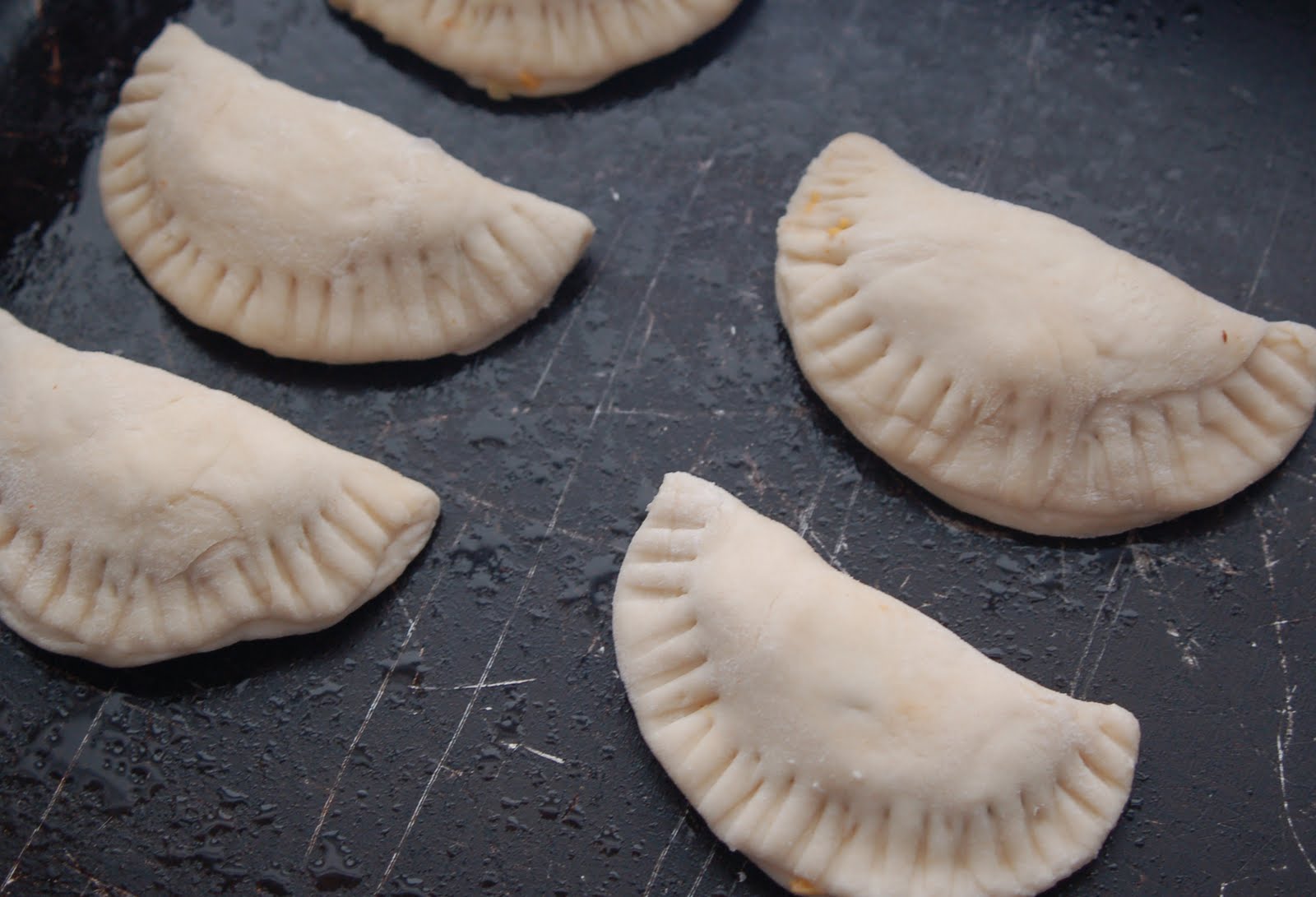
I also tried my hand at mini empanadas. Little filled pastry half moons, these were a bit more work. Utilizing a dough recipe from America’s Test Kitchen, I made a vegetarian version based on black beans. The dough itself is the complicated part, having freeze the butter, carefully and quickly mix the dough, refrigerate, roll half, refrigerate, roll half, refrigerate, fill. I ended up doing the dough one day and the rolling and filling the second day. The tricky part was getting the dough thin enough. Too thick and all you taste is the pastry part of the empanada, too thin and the filling breaks through. I finally got the technique down though. I baked several to make sure the flavor was there, but froze the rest for baking the night of the party.They are cute and you can make any manner of filling: beef, chicken, pork, chorizo, pepper and cheese, the combinations are endless. I used a combo of black beans, avocado, shredded cheese, and green onions, bound by salsa and with a few spices thrown in.
Mini Empanadas
3 3/4 cups unbleached all-purpose flour
1 tablespoon sugar
1 1/2 teaspoons salt
¾ cup unsalted butter, chilled
1 1/4 cups ice water
Filling of your choice
1 egg, beaten
Cut up the butter into small cubes and freeze for 10 minutes. Assemble the rest of the pastry ingredients.
Process the flour, sugar and salt in a food processor until combined, about 6 seconds. Scatter the butter pieces over the flour mixture and pulse until the mixture resembles coarse crumbs with butter bits no larger than small peas, about 16 pulses.
Transfer flour mixture to a large mixing bowl. Working with 1/2 cup of water at a time, sprinkle the water over the flour mixture and stir it in using a rubber spatula, pressing the mixture against the side of the bowl to form a dough, until no small bits of flour remain (you may not need to use all of the water).
Turn the dough out onto a clean work surface and divide it into 2 equal pieces. Press each dough half into a cohesive ball, then flatten the ball into a 6-inch disk. Wrap each disk in plastic and refrigerate until firm but not hard, about 2 hours or up to 2 days.
Line 2 baking sheets with parchment paper; set aside. Remove 1 disk of dough from the refrigerator (if refrigerated longer than 2 hours, let sit at room temperature until malleable). Roll the dough out on a lightly floured work surface into an 18-inch circle about 1/8 inch thick. Using a 3-inch round biscuit cutter, cut out 24 rounds and transfer them to the prepared baking sheet. Do not reroll the scraps as the dough gets very hard and makes for an unpleasantly tough empanada.
Wrap the baking sheet with plastic wrap and refrigerate. Repeat with the second disk of dough and the second prepared baking sheet.
Working with the first batch of dough rounds, place about 1 teaspoon of the chilled filling in the center of each dough round and moisten the edge of the dough round with water, using either your finger or a pastry brush. Fold the dough in half over the filling, making a half-moon shape. Pinch the seam along the edge to secure. Using a dinner fork, crimp the sealed edge to secure. Arrange them on a fresh, parchment-lined baking sheet. Wrap the baking sheet tightly with plastic wrap and refrigerate while making a second batch of empanadas using the remaining dough rounds and filling.
Brush empanadas with beaten egg and bake in a 425-degree oven for 20 minutes.
TO FREEZE FOR LATER USE: Place trays of empanadas in the freezer for 6-8 hours, until empanadas are frozen. Place in a Ziploc bag until ready to use. To cook, place frozen empanadas of parchment lined baking sheet, brush with beaten egg,and bake at 425 degrees for 25 minutes.
Black Bean Filling
1 can black beans, drained and rinsed
1 avocado, diced
½ cup green onions, minced
1 cup finely shredded cheese (jack, cheddar, jalapeno jack)
Mr. B and I found ourselves in Reno last weekend, cheering on our niece and her club volleyball team as they played to earn a bid to Nationals in June. A four-hour drive was followed by 5 hours of volleyball matches, after which we deemed it necessary to indulge in some decent sustenance.
My first choice would have been to eat at one of the three Charlie Palmer restaurants, not only because we would be assured a good meal, but because they were located in the hotel we were staying in. But, alas, the gun show was in town, meaning the hotel was packed and reservations unavailable. Traveling for the first time in at least 5 years without my laptop, I had no way of investigating local eateries and making an informed decision. Not wanting to eat at the nearby Claim Jumper or a random hotel buffet, I called on Brilliant Daughter to Yelp me some choices.
The two most promising finds were the 4th Street Bistro, a hip localvore eatery that garnered rave reviews and was in the $$$ price range, and a local fave called The Gas Lamp. Also with good reviews, The Gas Lamp hit the $$ price point. What was most intriguing was it was kind of out of the way, frequented by locals, and had one review that stated, “Don’t let the outside appearance fool you.” I learned long ago not to judge a restaurant by its façade, and was now curious as to what it looked like.
Joined by our sister-in-law and fellow volleyball mom Linda, we all agreed we should at least drive by and check it out. Besides, it gave us a chance to cruise down Virginia Street, the main drag and home to the famous “Smallest Big City in the World” sign. Amazing how many tattoo and piercing parlors there are, mingled among the hotels, bars and casinos. Not sure that alcohol-fueled body modifications are a wise idea, but they certainly would serve as a unique souvenir.
Located off Virginia Street, between the downtown and the convention center, The Gas Lamp is in a nice but nondescript stucco building with ample parking and a bright red door. All four of us voted to take a chance and check it out. We were greeted warmly upon entering and the staff quickly set up a table for us.
Seated on eclectic antique chairs around a large antique table, we perused the one-page menu that consisted of starters, soups/salads, and entrees. While the salmon carpaccio and ahi tuna tartare sounded wonderful (and probably much healthier), we opted on the grilled artichoke ($5) and the spicy fries with garlic aioli ($5). The artichoke was cooked perfectly, steamed and grilled, served with a pesto aioli. The only downside—it was only half an artichoke. The fries, however, were plentiful and had a bit of a kick to them. Thin and light, we managed to whittle the pile down to nothing while partaking in witty banter and snarky criticism of the day’s events.
We passed on the soup of the day, homemade roasted tomato, and the choice of three salads, as reviews indicated it worth saving room for dessert. Dinner choices included the house specialty, a 14-ounce pork chop, brined for 24 hours then cross-grilled, and served with a Yukon mash and stuffed baked apple. While we all seriously considered this selection, 14 ounces of pork is way too much to eat in one sitting, so we passed. The adjoining table did order this dish and we all agreed we had pork envy upon seeing it. Still, we opted for lighter fare, with three of having the grilled tilapia with toasted almond rice and grilled asparagus ($18) and Mr. B salivating over the orange-jalapeno prawns, also served with the rice and some very nice al dented French green beans ($19). Also available were two pastas, steelhead trout, rib-eye steak, and a burger.
The tilapia was grilled and had a slight smoky flavor but was moist. The portion was perfect, as was the rice and asparagus. Mr. B enjoyed the prawns, and although they were liberally sprinkled with diced jalapenos, he would have liked a bit more heat. I found them to be just a tad too sweet, but with good flavor overall.
Dessert was the highlight of the meal. The chef rotates desserts ($8) regularly and makes his own ice cream. There is no menu, just a short recitation from Sean, our helpful waiter. The night’s offerings: Black, blue and marionberry crisp with the homemade vanilla ice cream, pineapples Foster, and a triple chocolate brownie (no nuts) served with the same vanilla ice cream. Needless to say we ordered one of each for the table.
I’m not a fan of bananas, so I’ve never ordered bananas Foster (although Mr. B loves it), but this twist on an old standard was divine and clearly my favorite of the evening. Two moderate sized scoops of vanilla ice cream topped by the sautéed and carmelized fresh pineapple and finished with toasted coconut. Yummy to my tummy, really. The berry crisp drew rave reviews from all and was the fave of my three dining companions. My sister-in-law was ready to come back and have it for breakfast…and lunch…and dinner. The brownie was generous with hunks of chocolate throughout. The sweetness and dense chocolate flavor was cut by a scoop of the chef’s ice cream. Nothing spectacular but enjoyable nonetheless.
The Gas Lamp has a one-page wine list with several single glass options (most $7-10), as well as a full bar.
4 people – 2 apps – 4 entrees – 3 desserts – 2 ice teas – 1 glass merlot – 1 tequila = $126 + tip. I would highly recommend trying this local eatery, both for the pleasant staff and good, fresh food.
I have been blessed along the way with many different food influences, family and friends who have helped guide me down a path in a specific direction. My nana and my mother-in-law both taught me heritage cooking, while over the years my friends have contributed with Chinese, Italian, and even vegetarian cuisines. One strong influence, beginning in my late teens and continuing to this day, has been my godparents, Joyce and Max Sosebee. It is because of them that I cherish my annual garden, learned to can, and my children know the taste of fresh fruit eaten right off the tree. They, as well as their whole extended family, have helped to shape who I am in the kitchen.And today is the day to honor and give thanks for that.
Most people know little about their godparents. Bonded by ritual, the need for godparents has decreased in our society, where individuals live an average of 78 years. There is no longer that pressing need to appoint a spiritual or physical guardian for our children under the assumption we will die an early death. While the rite is still practiced, godparents don’t have the same role or meaning they once did. But that doesn’t make them obsolete or unnecessary. I recently witnessed a wedding where the godparents were intimately involved, not just in planning, but in the ceremony itself and it was touching. I, too, have been on the receiving end of generous godparents, and am eternally grateful to my parents for having brought them into my life. They have been a gift beyond imagination; an extra set of parents to guide me, provide counsel, and who taughtme the value of food, the garden, and the joy of family.
Growing up, contact with my godparents occurred on holidays and birthdays. A quick few hours here and there, at our house, at theirs, and at my godmother’s family home nearby. In fact, it is at that home that I have the fondest of memories. It is a house I visited every Christmas as a child. We would drive up the road to the house, pull into the circular driveway and enter a holiday wonderland that was filled with family. And I do mean filled. Grandma and Grandpa, three daughters with their spouses and six children. Fourteen people cohabitating for several days under the auspices of Santa Claus. It made my own family seem so small by comparison. I loved all the activity, all the food, all the joy that was in the air. (This made me realize early on that I wanted my own big family, and I now have something that approximates that, although in truth many of these “relatives” are not related by birth or blood or marriage, they are family of my own making, but family nonetheless.)
As I got older, I began to spend more time with my godparents both in work and play. During one college summer I was hired on to work the swing shift at the family’s food business, Carriage House. Producers of high-quality jams, jellies, peanut butter, and pie fillings (among other items), I worked the line, enjoying the daily aromas of strawberry jam, fishing for pineapple “eyes,” making cute little individual jam cups for restaurants. I lived in their home, gained two brothers, and had my first real exposure to a home garden. Tucked behind the garage in what seemed to me a secret garden was a bounty of tomatoes and peppers and vegetables of all kinds. I was introduced to the world of canning. I saw tomatoes come right off the vine that at the end of the day made beautiful jars of tomato and pizza sauce. I ate my first homemade pizza with this sauce, on even fresher dough my godmother had made.I had my first taste of green-fried tomatoes, stuffed zucchini flowers, fresh chard, and other foods influenced by both my godfather’s Southern Tennessee roots and my godmother’s Italian heritage. It opened my eyes.
Not long after my own children came along, my godparents moved closer, back to the family home I had known only at Christmas. It was a suburban oasis, an acre and a half of fruit trees, multiple vegetable plots, and a glistening blue pool. From apples to figs to nectarines, almost every fruit was represented there. Some of the largest onions I have ever seen were dug out of this soil. We played horseshoes next to the artichoke plants, putted golf balls under the pomegranate, and played hide-and-seek among the apple trees behind the garage. My children learned to swim here, but more importantly they learned how food is grown, able to pluck a carrot out of the ground or a peach from the tree for a snack. When my godparents traveled, my children helped me water and tend to the garden. I learned about drip systems, rotating crops, and the joy of Meyer lemons. I made pies from the apples, curd from the lemons, pizzas topped with fresh vegetables.
I was inspired to plant my own garden and my own Meyer lemon trees in our first house, which my godparents helped us acquire. We had an herb box, a large vegetable garden on the side of the driveway, and even our own secret garden, hidden behind a fence in what was a narrow unused side yard. I began canning my own salsa, jams, fruits. The shelves in my small basement were lined with the offerings from both our gardens and saw us through some leaner times.
It wasn’t just my godparents who contributed to my development, as their own large family has also aided me on my journey to be a better cook, to make better food, to try new things. While I never did try my godfather’s fried okra, I had my first introduction to biscotti courtesy of Grandma Mary, my godmother’s mother. Loving the crunch and “dipability” of this twice-baked cookie, I began experimenting with different flavor profiles to suit my own tastes. I now regularly make four versions of this Italian treat: a somewhat traditional almond (no anise for me), lemon-pistachio, almond crunch, and espresso).
And then there is the farm. LJB Farms in San Martin, about an hour south of my home, has been owned and operated by the Bonino family for 92 years and is currently run by Judy (my godmother's sister) and Louie Bonino and their two sons, Russell and Brent. In addition to everything they grow, they operate a farmstand, in what is called "The Barn." This renovated barn is filled with the fruits of their labor, along with other local growers and purveyors. This is where I come to get my lugs of Blenheim apricots, Santa Lucia peaches, heritage tomatoes, strawberries, pickling cucumbers and anything else in season. Brilliant Daughter and I drive the 53 miles to fill up the back of the car and then spend the whole weekend trying to can as much as possible. One weekend last summer we went a bit overboard and ended up with 24 quarts of pickles, 43 half-pints of jam, 3 quarts BBQ sauce and 1 ½ quarts of salsa. Yeah, the produce is just that good.
The lessons learned, however, were not just about family and food. I learned the value of hard work, the need to treat people fairly, and generosity of spirit. I have watched my godparents persevere through the darkest of days and been amazed at their strength, dedication and sheer will power. I have shared with them life and death, joy and grief.
The path I have taken, both in my food and personal life, has been directly influenced by this generous family, by the love of my godparents, by their willingness to share their home, their heart and their heritage with me. For this I will be forever grateful and I thank them today, and every day for the blessings they have provided.
As you may know, my Meyer lemons have been waiting patiently on the tree to be picked and utilized once the kitchen was complete. While we are still missing a few crucial items (like 5 cabinet doors!), westarted out with lemon curd two weeks ago and I have been testing lemon recipes for Easter dessert.
First up was a lemon budino, which I made for Sunday dinner a few weeks ago. We were having pork sugo over pappardelle and we needed something light to finish off the meal. The budino is a cross between a cake and a custard, baked in little pots de crème or ramekins. They are light and airy with a bit of soft custard at the bottom of the pot. Kind of like a surprise ending to the meal. They puff up and brown in the oven, only to fall slightly and crack upon cooling. I served them with just a topper of whipped cream. While I thought they were okay, they were nothing to really rave about or even pass on the recipe.
Last Sunday I tested out a recipe for a lemon mousse. A recipe I had been saving since 2006. It involved making a lemon pudding on the stove, then cooling it down and mixing it with whipped cream. I served these in wine glasses topped with a berry, but it was too much lemon, not enough berry. Part of the problem could have been that it made 8 servings, but I crammed the mousse into 6 wine glasses. (One of those things where you think more is better.) But in actuality, I think it should have been layered with berries, like a parfait. A dollop of lemon mouse, some fresh berries, more mousse, and topped with berries. You could easily get 10 servings out of the recipe this way and it would have been tastier, less caloric, and actually prettier to look at.
I followed all this up with a Meyer Lemon Semifreddo, a recipe I had clipped out of Bon Appetit in June of 2008. I needed a make-ahead dessert for Easter. My nephew was getting married on Saturday about 3 hours away. So we needed to get up early, get on the road, and had to stay the night. We wouldn’t be returning until Easter at noon, and 14 guests were expected at 2pm. So in addition to my bittersweet mousse torte, I made this light and delicious semifreddo.
A semifreddo is a semi-frozen dessert. It doesn’t freeze as hard as ice cream but has a similar custard base. This particular recipe has an extra step where you whip the lemon custard base, making it fluffy and almost ethereal, (I realize ethereal is not really a word associated with food, but it just seemed to fit so perfectly.) Served with toasted almonds and a fresh berry medley, it was the hit of the party.
While it takes close to an hour to make, it can be done up to 3 days ahead. I used a longer and narrower loaf pan (11x4x3), as I think that standard loaf pans make too big of a slice. This is very rich, and you can only eat just so much, but it does serve 10-12, depending upon the thickness of the slices.
Meyer Lemon Semifreddo
1/2cupsliced almonds, toasted
1 3/4cupschilled heavy whipping cream
1 1/4cupsplus 2 tablespoons granulated sugar
7large egg yolks
1/2cupfresh Meyer lemon juice (or regular lemon juice)
4cupsmixed fresh berries (such as raspberries, blackberries, blueberries, and quartered hulled strawberries)
Line 9x5x3-inch metal or glass loaf pan with plastic wrap, leaving generous overhang. (You can also use a longer, narrow 11x4x3-inch pan to make smaller slices and serve more guests.) Sprinkle almonds evenly over bottom of pan.
Using electric mixer, beat whipping cream in large bowl until soft peaks form. Refrigerate whipped cream while making custard.
Whisk 1 1/4 cups sugar, egg yolks, lemon juice, lemon peel, and salt in heavy medium-sized saucepan. Place on medium-low heat, whisking constantly until yolk mixture is thick and fluffy and instant-read thermometer inserted into mixture registers 170°F, about 4 minutes. (You can also do this in a double boiler.) Remove bowl from over simmering water.
Using electric mixer, beat mixture until cool, thick, and doubled in volume, about 6 minutes. Fold in chilled whipped cream. Transfer mixture to prepared loaf pan and smooth top. Tap loaf pan lightly on work surface to remove air pockets. Fold plastic wrap overhang over top to cover.
Freeze semifreddo until firm, at least 8 hours. (This can be made up to 3 days ahead of time.)
Gently mix all berries and remaining 2 tablespoons sugar in large bowl.
Unfold plastic wrap from top of semifreddo and invert dessert onto platter; remove plastic wrap. Dip heavy large knife into hot water; cut semifreddo crosswise into 1-inch-thick slices. Transfer to plates; spoon berries alongside and serve.
I'm having to prepare in advance for our Easter dinner, as we head to Marysville on Saturday for my nephew Marshall's wedding. I am expecting 14 for a 5pm supper, meaning lots of advance work on my part.
This morning was the Easter eggs. I was determined to use what was in my house. I scoured my office and my yarn and craft closet for anything that I could find. I discounted all the Celtic stamps, the silver glitter and the multi-colored sequins, the latter two a bit gaudy for my taste. But I did have some fun.
After dying my 18 hard-boiled eggs in the standard 1 cup water/1 tablespoon vinegar/6 drops of food coloring, I organized my finds. Laid out on the red rosin paper that the contractors used to protect my new hardwood floor from injury, it all seemed a bit random and you will probably laugh at my attempt to be Martha Stewart. (I am much more creative in the kitchen than in the craft arena.) Assembled to the left are a few samples of my efforts.
The first is a simple egg, wrapped with ribbon and some little rosettes I had (for what, I do not know). Number 2 is made of tissue paper that I cut with pinking shears. All I had was some shimmery white paint to use as glue, but it seemed to work find. Number 3 has white correction tape bands and then is painted with a coat of the same shimmery white paint. 4 and 5 allowed me to take advantage of my large button collection, something I inherited in an old large canning jar. The last one is for my niece and nephew, both Catholic and missing their annual Easter church festivities to come north and visit family.
Next task is to head out to do some shopping. The menu as it stands now is a tribute to my late mother-in-law, who always put on a wonderful Easter feast, in the tradition of her husband's family who are of Lebanese descent.
Shish Kebab Lebanese Rice Green Beans in Homemade Tomato Sauce Cucumber, Tomato and Feta Salad Flat Breat Hardboiled Eggs (of course)
Meyer Lemon Semifreddo with Berries Chocolate Truffle Loaf with Berry Coulis